
As the days get longer and the weather gets warmer, routines naturally start to shift. Weekends become busier, social events pick up, vacations get booked, and suddenly the structure and routine that once made consistency feel easy can start to fade.
If you’ve ever felt like spring and summer tend to throw you “off track,” you’re not alone, but you don’t need to start over every fall. Over the next couple of months, we are going to be breaking down how you can stay on track with your weight loss and fitness goals this spring and summer by using a balanced approach (and without extremes.)
Let’s dive into part one of this two part series!
1. Redefine What “On Track” Actually Means
The truth is, your routine is supposed to flex with your life, especially as the seasons change and the weather begins to warm up. When you define “staying on track” too rigidly, even small deviations can lead to feelings of failure, which leads to giving up altogether. As you can see, this easily turns into a cycle if we don’t shift these patterns of thinking.
Instead of asking, “Did I do this perfectly?” start asking:
- “Did I make a choice that supports my goals in some way?”
- “Can I get back to my routine at the next opportunity?”
These shifts in your thought patterns remove pressure and replace it with momentum, helping you to find balance between your goals and your real life. Progress is in how quickly you can pivot and keep moving forward.
2. Set Your Non-Negotiables
When life gets busier, it helps to have a few anchors to keep you grounded. These are your non-negotiables, or the habits you commit to no matter what your schedule looks like. Think of your non-negotiables as your “bare minimum wins,” or the habits that keep you feeling your best even when everything else feels chaotic.
The key here is to keep these as realistic as possible. If your non-negotiables are too ambitious, they quickly become optional or unattainable (i.e. another thing on the to-do list you can’t get to.) However, if they’re simple and truly achievable, they create consistency even in the busy seasons.
On weeks where motivation is low or your schedule is packed, these habits become your fallback plan. And more often than not, sticking to a few key behaviors is what prevents you from feeling like you’ve completely fallen “off track” (see tip #1! 😉)
Examples of some realistic non-negotiables:
- Aiming to eat 0.25-0.4g protein/kg of BW (20-40g) with every meal.
- Focusing on strength training at least 2 times per week, working all major muscle groups with 4-8 exercises per session/2-3 sets per exercise. (If you need help coming up with a plan, this is exactly what I can help you with!)
- Drinking enough water daily.
- Getting 7+ hours of sleep (as often as possible.)
- Including fruits and veggies daily (or better yet, at every meal.)
These aren’t about doing everything, but more about doing what matters the most to you and your individual health and wellness goals.
3. Plan Ahead for Social Events (But Don’t Plan to Restrict)
Spring and summer come with a LOT of social events – BBQs, parties, vacations, family gatherings – you name it. And yes, these events typically include the cultural foods that matter to you (and that you enjoy most!)
Many people go into these social events with one of two mindsets: “I have to be perfect,” or “I’ll just start over tomorrow.” Both lead to the same place of frustration. But you don’t need to avoid these moments, or avoid the gatherings altogether.
Let’s talk about some alternatives!
- Go in with a plan and don’t arrive starving. Planning ahead doesn’t mean controlling every detail, but rather giving yourself some structure so you can enjoy the event without feeling out of control. Also, be sure not to skip meals leading up to the event (more on this up next.)
- Build a balanced plate whenever possible (think ¼ of the plate protein, ½ fruit and vegetables, and ¼ starch/carbohydrate.) Along with this, decide what foods you’re the most excited about and prioritize those when deciding what to eat.
- Focus on proper portion sizing, not restriction. As you eat, check in with your hunger and fullness levels. Focus on connecting to those around you, but don’t forget to connect with yourself too!
When you remove guilt and add intention, these events stop feeling like setbacks and start becoming part of your regular routine. Reaching your weight loss goals stems from what you do consistently, not one meal or one event.
4. Don’t Skip Meals to “Save Calories”
As we briefly discussed with tip #3, while it might seem strategic in the moment, “saving calories” or restricting food early in the day (whether you have an event planned or not) often creates a ripple effect that works against you.
When you go too long without eating, your hunger doesn’t just gently increase, it actually intensifies. Then by the time you get to your next meal, you’re no longer making intentional choices. You’re ravenous and reacting to extreme hunger, leading to feelings of being “out of control” around food.
A more effective approach is to eat regular, balanced meals throughout the day, and to think of meals as a way to support your choices later, not “take away” from them.
You can visualize this as a simple comparison:
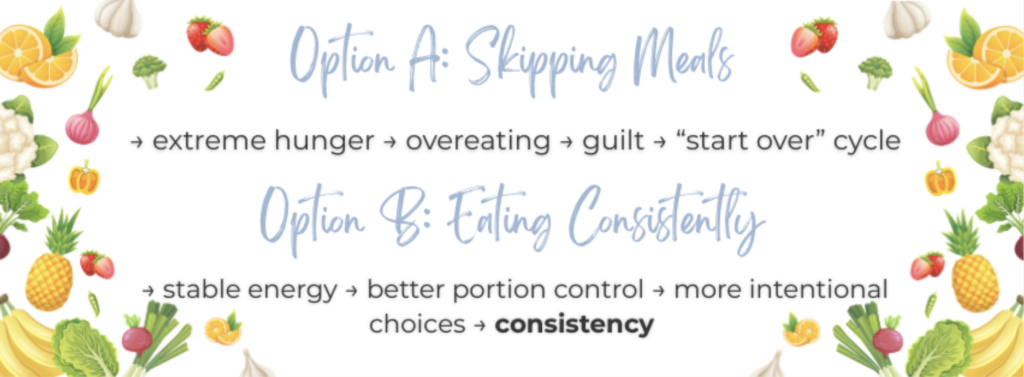
No matter how crazy the day or how out of routine you are, you’re better off aiming for balanced meals to keep you grounded (not ravenous and out of control!)
Final Thoughts
Warmer months don’t have to derail your progress. In fact, they can become the season where you finally learn how to make your goals fit your life, not the other way around.
Next month, in part two of this series, we’ll build on all of these great tips with even more strategies to help you stay consistent through the busy months ahead.
If you’re tired of starting over every year and want a more sustainable, balanced approach to weight loss (one that still includes the foods you love), this is exactly the kind of work I support my clients with. Let’s explore what working together could look like for you!